Showing posts with label Race. Show all posts

Tuesday, June 21, 2022

Radicals’ Are Racist Criminals Driving America towards the abyss. 06, 17, 22David Horowitz176 comments


 Our nation's current crisis is a crisis of faith
– faith in the Constitution that has shaped our destiny, faith in the rule of law, and faith in the principle of equality before the law. The root cause of the lawlessness consuming our country is the monopoly of the executive power in Washington by a political party that has fallen under the control of the radical Left. This Left describes itself as “progressive” but is focused on the goal of “re-imagining” American institutions and principles, in other words, of dismantling the constitutional order that created the prosperity and freedoms that have shaped this country since its beginnings.


Having been born into this political Left and then rejected it, I have acquired an intimate perspective on its nature, and the threat it poses to the American future, which is grave. I was raised by Communists who always referred to themselves as “progressives,” and were sworn enemies of America and its institutions, as was I. We saw ourselves as warriors for social justice, acting on the “right side” of history.

We could not have been more mistaken. The “moral arc” of history is not “bent towards justice,” as progressives like to say. If it were, the 20th Century would be the most enlightened instead of the scene of the greatest atrocities and oppressions on human record. Worse yet, for this progressive myth, these atrocities and oppressions were perpetrated by progressives in the name of “social justice.”

The practical achievement of the revolutionaries was the dismantling of whole societies, and their reconstruction as national prisons, and slave labor camps. Supported by progressives everywhere, Communists bankrupted whole continents while killing more than 100 million people – in peacetime – in order to realize their radical schemes. Their atrocities and failures continued until the day they saw their progressive future collapse under its own weight. This failure was entirely predictable because as every similar attempt to “re-imagine society” and change it by force has shown, it is simply beyond the power of human beings to create a “just” world. 

Forty years ago, a series of tragic events that I have described in my autobiography, “Radical Son,” stopped me in my tracks, and caused me to re-evaluate what I had believed until then. These second thoughts turned me against the cause to which I had been devoted since my youth, and which I now saw as a threat to everything human beings hold dear. Most of my generation of radicals, however, chose to continue on their destructive course. Over the next decades I watched the radical movement I was born into infiltrate and then take control of the Democratic Party and the nation’s cultural institutions, until one of its own, Barack Obama, became President of the United States. 

From the moment I joined the conservative Right forty years ago, I was impressed – and also alarmed – by the disparity in political rhetoric used by the two sides fighting this fateful conflict. My radical comrades and I always viewed these battles as episodes in a war conducted by other means – even as our opponents did not. Our rhetoric proclaimed our goals to be “peace,” “equality” and “social justice.” But this was always a deception. We used terms that demonized our opponents as “racists,” and “oppressors” because we believed our goals could only be achieved by vanquishing our opponents and destroying America’s constitutional order. 

The Constitution valorized political compromise and was built on the defense of individual rights – most prominently the right to own property.  America’s founders regarded property ownership as the basis of individual freedom. As radicals, we regarded property as the root cause of the evils that oppressed us. Consequently, the principles we operated under were not the same as those we gave lip service to in order to win public support. 

The Bolshevik revolutionary Leon Trotsky explained our attitude in a famous pamphlet called “Their Morals and Ours.” “Their” morals, he denigrated as bourgeois morals. They were morals based on class values that served the oppressors. One can hear the same sophistry today in the Left’s attacks on meritocracy and standards as “racist,” and in their demands for equal outcomes regardless of whether they are earned or not. 

While “their morals” served a ruling class, “our morals” served the people, and therefore social justice. Because we believed these propositions, “our morals” were by default Machiavellian: The end justifies the means. 

Trotsky’s pamphlet was, in fact, a desperate attempt to avoid admitting that there was anything amoral or immoral in this cynical outlook. He did so by denying the existence of moral principles, claiming instead that all morality was self-interested and designed to serve a class interest. “Whoever does not care to return to Moses, Christ or Mohammed,” i.e., to accept universal moral standards, Trotsky argued, “must acknowledge that morality is a product of social development; that there is nothing invariable about it; that it serves social interests; that these interests are contradictory; that morality more than any other form of ideology has a class character.”

But this is just an admission that “our” morals were indeed accurately summarized as, “the end justifies the means.” The future we imagined we were creating was so noble that achieving it justified any means to get there, which included the lies that hid our destructive purposes, and the atrocities they led to.

The full import of this belief was brought home to me in the spring of 1975 when our so-called “anti-war movement” forced America out of Indo-China, allowing the North Vietnamese and Cambodian Communists to win. For more than a decade, we had claimed to care about the people of Indo-China, championed their rights to self-determination and condemned the war as a case of American imperialism and American racism oppressing Asian victims. 

By the time America withdrew from the conflict and abandoned its Indo-Chinese allies, I already knew that Communism was a monstrous evil. But I remained a supporter of the “anti-war” cause, and of the rights of the Indo-Chinese to self-determination. To defend the commitments I had made, I deluded myself into believing that self-determination meant the Vietnamese and Cambodians should be able to choose even this evil if they wanted. This was so much sophistry because I knew that the Communists would not give them an inch of space in which to breathe free. The end that justified my position was that I believed America was the world’s arch imperialist power and its defeat was an absolute good.

What I was not prepared for was the moral depths to which the movement I had been part of had sunk. These depths were revealed in the events that followed the Communist victory. When America left Cambodia and Vietnam, the Communists proceeded to slaughter between two and three million peasants who were “politically incorrect” and did not welcome their Communist “solutions.” It was the largest genocide since Hitler’s extermination of the Jews. In Cambodia they killed everyone who wore glasses on the grounds that as readers they would transmit the oppressive ideas of the past and obstruct the Communist future. But there was no resistance to these atrocities from the “anti-war” Left.

As the genocidal slaughter proceeded, prominent Leftists like Noam Chomsky provided cover for the Communists’ crimes by denying that the atrocities were taking place. More disturbingly, there was not a single demonstration to protest the slaughter by the activists who claimed to be “anti-war” and to care about the Cambodians and Vietnamese. This silence unmasked the true agendas of the movement I had been part of.

My comrades’ abandonment of the peoples they claimed to defend showed in a definitive manner that the anti-war movement was never “anti-war.” It was anti-American. It wanted America to lose and the Communists to win. Progressives had lied about the nature of their movement and its agendas in order to accomplish their real goal, which was the “fundamental transformation” of America and the creation of a socialist state. I had known this to be the case for many years, but had accepted the lies because they served what I imagined was a noble end. But when the lies led to the embrace of genocide, my eyes were opened to the realization that the movement I had been part of my whole life was evil.

On my way out of the Left, I spent several years re-thinking what I had believed, and trying to understand the nature of the cause that I had served. Perhaps, my most profound and certainly most disturbing conclusion was that revolutionaries were by nature – and of necessity – criminals, who would routinely lie and break laws to achieve their ends. Every radical who believed in a “revolution” or a “re-imagining” of society from the ground up, every progressive who believed in a “fundamental transformation of America” as Barack Obama described his own agenda on the eve of his 2008 election, was a criminal waiting to strike.

America’s Constitution includes methods to amend it, and therefore to reform the American social order when and where changes are needed. In making such changes there are procedures to ensure that these changes represent the will of the American people, and are done lawfully. But revolutionaries do not respect a constitutional order created by rich, white men, many of whom were slaveowners. Radicals believe instead that “social justice” requires them to dismantle the social order, and “due process” along with it. Radicals are not “reformers.” In the name of social justice, they refuse to be bound by the laws and procedures that an unjust and oppressive “ruling class” has created. The end justifies the means.

Before President Obama – a constitutional law professor – decided to break America’s immigration laws and grant 800,000 illegals resident status, he admitted to his fellow Americans on 22 public occasions that he had no constitutional authority to do so – none. Creating such an amnesty by executive order was illegal and unconstitutional. And he knew it. But he did it anyway because to him and his party, violating the fundamental law of the land was justified because the system that had created the law was oppressive and unjust – racist. In committing this crime against the nation he led, Obama was guided by a radical ideology that justified the illegal means as a victory for “social justice.”

As a former radical I understood how high the stakes had become with Obama’s election. Since the Right was defending America’s freedoms while the Left was paying lip-service to patriotic pieties but intending nothing less than the destruction of constitutional order, I also understood that the rhetorical disparity between the two factions posed a grave threat to America’s future.

In fighting this cold war, progressives regularly demonize Republicans as racists, white supremacists, insurrectionists, Nazis and traitors. Republicans respond to these reckless attacks by calling Democrats “liberals” and similarly tepid descriptions. For example, they describe Democrats as “soft on crime.” Democrats are not soft on crime. They are pro-crime: Democrat prosecutors have systematically refused to prosecute violent criminals; Democrat mayors and governors have released tens of thousands of violent criminals from America’s prisons, and abolished cash bail so that criminals are back on the streets immediately after their crimes and arrests; Democrat mayors did nothing to prevent the mass violence orchestrated by Black Lives Matter in 220 cities in the summer of 2020, provided bail for arrested felons, de-funded police forces, and instructed law enforcement to stand down in Democrat-run cities, which allowed “protesters” to loot and burn, and criminal mobs to loot and destroy downtown shopping centers.

Democrats regard the criminal riots that took place in the summer of 2020, as social justice. The riots cost $2 billion in property damage, killed scores of people and eventually thousands as their “De-Fund the Police” campaign triggered a record crime wave in America’s major cities. Democrats regard criminal lawlessness and mayhem as understandable responses to what they perceive as “social injustice” – courts and the law be damned. To them, mass lootings are “reparations,” and individual robberies and thefts a socialist redistribution of wealth.

If you are in a battle of words – which is the nature of political warfare – and you are calling your enemies “liberals,” portraying them as not really understanding the gravity of what they are doing, while they are calling you “white supremacists” and “Nazis,” you are losing the war.

Why are Republicans so self-destructively polite? Why do they fail to see, or to identify their opponents as the criminals they are – or, at least, when they are? 

Ever since Donald Trump won the Republican Party’s presidential nomination in 2016, Democrats have conducted a verbal war against white America. This war has been so effective that Gallup polls show that 61% of Democrats think Republicans are white racists. At the same time the Biden administration has made “Equity” a centerpiece of its policies and programs. “Equity” is a weasel word to cover a socialist agenda. The White House defines “Equity” as privileging select racial groups with government largesse on the basis of skin color – a policy that is racist, inequitable, unconstitutional, and illegal.

Even when it is the government doing the redistribution and not street mobs, “social justice” – the policy of equalizing outcomes among politically select groups, regardless of merit – is another name for theft. Redistributing income on the basis of race is not equity, it is racism. Joe Biden is the first overt racist to occupy the White House since Woodrow Wilson – who not coincidently was also a progressive Democrat. Yet Republicans avert their eyes from this anti-American travesty. Why don’t Republicans call Democrats out for their racism?

Over the years I gave a lot of thought to these questions, and eventually I came up with an answer that should have been obvious in the first place. The disparity in rhetorical voltage between the two political parties stems from a fundamental disparity in outlooks, and more importantly in attitudes towards the future. The Left’s obvious goal is a “fundamental transformation” of American society. Such a transformation, as I have already observed, requires a dismantling of the existing social order. To justify this destruction, the Left creates narratives that provide it with ways to condemn and delegitimize the present and its defenders, and justify its criminal agendas.

Today’s Left is driven by a Cultural Marxist ideology, which is itself a product of the transformation of America’s universities and schools into one-party training and recruitment centers for the political Left. A similar colonization of America’s philanthropic institutions and corporate cultures has taken place enabling this ideology to become a conventional wisdom nationally and the strategic outlook of the Democrat Party.

Cultural Marxism, also known as Critical Race Theory, and also encapsulated in the historical travesty called “The 1619 Project,” has led to a narrative in which America is portrayed as a white supremacist, systemically racist nation since its inception. Cultural Marxists regard the Constitution as a white supremacist document written by slaveowners, and therefore not to be respected. Worse, according to The New York Times editors who sponsored the 1619 Project, its purpose is to demonstrate that, “nearly everything that has made America exceptional grew out of slavery.” This disgraceful slander against an entire people is an American version of “The Protocols of the Elders of Zion,” which is still used in many parts of the world to justify a genocide of the Jews.

From this script, it is relatively effortless for progressive activists to lift a single negative incident or atrocity from the complex history of the American Republic and frame an indictment of America’s very existence. The script always leads to the same conclusion: America is a society whose institutions are “systemically racist” and must be first demolished, and then “re-imagined” according to the dictates of “social justice.”

Conservatives approach politics from a diametrically opposed perspective. Unlike progressives, conservatives are not wedded to abstract ideologies that imagine a perfect future and use it to delegitimize an imperfect present. Conservatives seek to conserve the values of a remarkable Constitution, whose principles in actual practice have made America the world’s most prosperous, most tolerant and most free nation, and have inspired her to be a beacon of freedom throughout the world.

One consequence of conservatives’ regard for the proven virtues of the U.S. Constitution and the social order it made possible is the very diffidence conservatives and Republicans exhibit in their political battles with progressives. A primary concern of the American founders was the threat of “factions” whose outlooks and agendas did not encompass the well-being of the whole society but merely their own divisive interests and claims. A main theme of America’s founding documents, therefore, is the importance of compromise. The founders regarded attacks on the spirit of compromise as threats to the social order itself. The demonization of opponents by the Democrat Party is therefore anathema – or should be – to anyone who believes in the wisdom of the constitutional order. In other words, conservatives’ instincts are to willfully tie their hands behind their backs in order to support the well-being of the civic whole.

The Electoral College, to take one important example, is an institution the constitutional framers envisaged as a means of forcing compromise between warring political factions. Election by the College, instead of the popular vote, compels contending parties to compete in states where they don’t have natural majorities, and therefore need to compromise their agendas to win victories in “battleground” states. But radicals who abhor compromise are determined to abolish the Electoral College, justifying its abolition by smearing it as “racist.”

Another target of their anti-compromising zeal are the filibuster and the United States Senate which they denigrate as “undemocratic.” Of course, the Senate is undemocratic but that’s what the founders intended it to be. By giving lower population states equal senatorial power with higher population states, the founders ensured that the more populous states would not overwhelm the less populous ones and establish a “tyranny of the majority.” America is not a democracy; it is a republic, and that’s what the founders created –– and that’s why individual freedoms have been protected, and Americans have prospered.

The federal system and decentralization of power, vital to the freedoms Americans enjoy, are also instruments of compromise, and also abhorred by progressives who have been busily proposing legislation to federalize elections and police forces, and put them in the hands of a single centralized faction. The Democrats’ campaign to pack the Supreme Court and destroy the independence of the judiciary is yet another attempt to dismantle the constitutional system and consolidate power in the hands of a single faction. Their assaults on the First Amendment are equally sinister attempts to establish a one-party state.

Conservatives and Republicans are reluctant to use terms like “criminal” and “racist” and “fascist” to describe Democrats whose policies are criminal, racist and fascist because to do so would threaten the constitutional principle of compromise, on which civil peace and civil freedoms depend. Well and good, but in the current crisis defenders of America need to find a way to develop a stronger rhetoric, along with a more realistic attitude towards the enemy they are facing, if America is to survive at all. As long as conservatives continue to respect and enforce “due process” – which the Democrats have abandoned – there is no danger that they will follow in the destructive path the Democrats have chosen.

The principal weapon progressives have developed to advance their destructive agendas is race. But in responding to their attacks, Republicans – and conservatives generally – have displayed an unsteady hand. For example, Republican leaders like Mitch McConnell (R-KY) have referred to slavery as “America’s original sin,” in an effort to provide a compromising view. And they have often conceded that America had a regrettable racist past, and wrung their hands over it. Well and good, but to leave it at that does a grave injustice to the American reality. For there never was a moment in American history when there was not a white movement calling for the abolition of slavery and racism, and even willing to lay down their lives for it. 

To put this history in a more accurate perspective: America didn’t invent slavery, and accounted for less than one percent of the global slave trade. If slavery is anyone’s “original sin” it is Africa’s, where slavery existed for a thousand years before a white man ever set foot there. Virtually, every slave shipped to America was enslaved by black Africans and sold to Americans at auctions. America’s founding fathers – Washington, Jefferson, Madison – deplored the slave system but saw no way to abolish it immediately without a war with England and the South, which they would have lost. Eventually their heirs did fight a war to free the slaves that cost more American – mainly white lives – than all America’s subsequent wars combined. Every black descendant of slaves in America owes his or her freedom to white Americans like Thomas Jefferson, even though Jefferson was a reluctant slaveowner, or to Abraham Lincoln and the 360,000 Union soldiers who gave their lives to free the slaves. 

Is there in all history a comparable example of one race making such a sacrifice to free another? I am unaware of one. No American, mindful of their history, should turn their backs on this record, or bury it in silence, or compromise its truth.

When America’s racial past is viewed as a whole, Americans have no need to be ashamed. People who demand reparations for a slavery they never experienced, should sue the Confederacy, which fought to preserve it. They should not sue the United States government which made such enormous sacrifices to do the right thing. And no American patriots should make apologies for an American past that was shaped by lovers of freedom who set a standard for ending slavery not only in America, but also in the Western Hemisphere, and finally on global scale. For more than 60 years following the Emancipation Proclamation, America joined white Christian powers like Britain and France who sent gunboats throughout their empires to end the global slave trade. They were opposed by brown and black potentates who defended the institution and refused to free their human chattel. Black and brown slaveowners still thrive in Africa today.

The fact that these facts have been buried by progressives who control America’s cultural institutions, and who have replaced them with slanders worthy of America’s enemies underscores the enormity of the threat we face. The Democrats are now a national lynch mob. They have spent the last seven years in one attempt after another to destroy a president, whose political signature is “America First,” by libeling him, his supporters and the country they love as “white supremacist” and “systemically racist,” when there is no sound basis for either charge. They have broken precedent, tradition, protocol, and the law, and violated the Constitution to hang Donald Trump and demonize his supporters as “domestic terrorists” and “insurrectionists” – traitors – all in order to advance radical policies that have destroyed America’s borders, triggered record crime waves in American cities, and blown up the best economy in our lifetimes. 

To defend our country against these radical destroyers, Americans need to get a firm grip on the facts of their heritage and the realities of their present. In particular they need to understand that America never was a racist nation – even during the brief 20-year period when slavery was legal in the North, and the 76-year period when slavery was legal in the South. Not the alleged “400 years of slavery” as its ignorant and malicious enemies like Al Sharpton maintain.

Slavery in America was an English implant and the extension of an African business. There were 500,000 free blacks in America on the eve of the Civil War. That is inexplicable if America was actually a “white supremacist” nation. The slavery issue only became an issue of racial oppression when Southern slaveowners chose to defend their system in a nation dedicated to the proposition that all men are created equal, by arguing that blacks were not. What was distinctly American, however, was the declaration of equality, not the racist defense of slavery by soon to be defeated owners of slaves in the South.

Given the prejudices and bigotries that are endemic to human beings of all races, Americans can be proud of their racial past and its contribution to human freedom. The raw facts are these: Slavery was an inherited system, which Americans abolished in little over a generation. There never was a successful revolt by the slaves themselves. If whites had been as universally racist as Leftists maintain, blacks in America would still be slaves, and not the most prosperous, most privileged and free-est blacks in the world today, including all of black Africa and the West Indies.

Above all, conservative, patriotic Americans need to stop compromising the truth to appease their political enemies who want to destroy them and the country they love.

Saturday, June 4, 2022

WHEN WHITES COMPLAIN ABOUT RACISM TOWARDS THEM.


WHEN WHITES COMPLAIN ABOUT RACISM TOWARDS THEM.

Let's deal with the 800lb gorilla in the room. 

Anti-white racism is the name of that gorilla. It is fashionable these days to blame the white race for their every ailment.


The race hustle is this; black racist cons want white people to give them money that they didn't work for because people that owned slaves share the same skin color as modern whites that think the practice barbaric.. Black racist hustlers want you to blame yourself because of your skin color. 

That's stone-cold racism.


It is a sign of virtue for white liberals to humiliate themselves at the feet of these racists because the poor sheep have been socially conditioned to be ashamed of the color they were born with. 

That is a shameful degradation of the soul.


They work off a double standard

Saturday, August 28, 2021

The Surprising Origins of Critical Race Theory


The Surprising Origins of Critical Race Theory

Critical Race Theory (CRT) has been cited as an offshoot of Karl Marx’s theory of class struggle, which was designed to pit one class against another so as to foment worker-led revolutions. It is also widely accepted that the Marxian Frankfurt School in Germany reworked Marx’s “social conflict theory” in the 1950s by adding “race” to their long list of “oppressed” minorities. But historically, the Frankfurt School theorists were latecomers to the racial theory table. They were not the originators of Critical Race Theory. A revolutionary socialist movement had already existed decades before in Germany. These racial justice warriors sought to pit one race against another and encourage the oppressed to overthrow the oppressor. They called themselves German National Socialists.

After World War II, the Frankfurt School intellectuals and academics began to plagiarize the “racial struggle” and “victimhood” theories that had originated with Nazi theorists in the mid-1920s. It is true that the Nazi theorists, many with Marxist leanings, were less sophisticated in their racial superiority approach. But their long-term goals on racial disparity and struggle were remarkably similar.

The National Socialists, like the Marxian Frankfurt School leaders, dedicated themselves to fighting racial oppression imposed by other advantaged races. But in the case of the Nazis, they identified the “oppressed race” as the Aryan and German people and the “oppressor race” as the Jews. They believed that the Jews controlled the world as members of a wealthy and privileged race that supposedly mistreated the so-called Aryan races. 

To demean the so-called “Jewish oppressors,” the National Socialists taught German children that the Jews, Jewish-run banks, and capitalists were persecuting the German nation and its people. This “oppressor versus oppressed” narrative is pure classical Marxism, which had devastating effects across the annals of modern history. Such racist nonsense divides society, creating hostile tribalism and unending ethnic violence.

Of course, this racial struggle was exactly what the Nazi propagandists intended in their effort to purge certain “oppressor” races. They wanted only one race to exist in German-controlled lands. That is why Critical Race Theory is so poisonous. Its endgame almost always results in horrific final solutions to punish so-called privileged and oppressor races.

The march towards securing superiority over an oppressor race began in earnest after the Nazis nationalized most German schools in 1933.  School administrators quickly inserted racist policies into newly rewritten textbooks and school policies. With the assistance of the National Socialist Teachers League, (the official Nazis teacher’s union), students were inundated with racial theories that invaded most disciplines. Nazi party officials promoted the Führer’s Volksgemeinschaft concept of equality, which included social engineering, social justice, racial tribalism, national collectivity, and social Darwinism. But their biggest mission was to implant biased ethnic-racial studies into Germany’s classrooms.

According to Richard J. Evans in The Third Reich in Power 1933-1939, Nazi educators and administrators from the Education Ministry mandated that the topics of “racial biology” and “racial science” be inserted into almost every school course across Germany. Biology was heralded as the key to understanding and identifying racial differencesThe National Socialists even developed a racial-social arithmetic for their textbooks to indoctrinate students. For example, this racial mathematics used formulas to design calculations that would determine how many blond Aryans lived in a German population.

The German language did not escape this politicization of education.  Language had to focus on speech patterns to provide a racial background that would subliminally implant German schoolchildren with the racial-socialist ideology of Nazism.  The study of geography had to bow to a racial makeover that required Nazi ideology to be more compatible with heroism, home, and race. Amazingly, Nazi educators even found ways to link climate to race.

Not surprisingly, such old-style racism is now returning to our world, mostly voiced by progressives, the woke mob, and Black Lives Matter. Similar to the National Socialists, this orthodoxy is a hodgepodge of social justice, oppressor-versus-oppressed victimhood, and racial tribalism. A German poster from 1933 highlights the Nazi’s dedication to a socially just racial state, proclaiming, “Because Adolf Hitler’s Third Reich wants social justice, big Jewish capitalism is the worst enemy of this Reich and its Führer.”

A number of present-day “anti-racist” activists are emulating the National Socialists’ pogrom policies. For instance, co-founder of Black Lives Matter in Toronto, Yusra Khogali, called for the extermination of certain races. Taking jabs at white privilege and oppressor races and gender, she mused in 2016 that she had an urge “to kill men and white folks.” Moreover, she tweeted that “white skin is subhuman.” Hitler and his Nazi horde spouted the same “subhuman” accusations against Jews, and eventually acted upon their convictions in the Holocausts.

The origins of Critical Race Theory have a dark history.  Why would anyone justify racism, racial superiority, or racial inferiority in today’s world? Such inflammatory rhetoric has never led to racial or social equality. CRT must be discarded into the ashbin of history, along with any resurgence of National Socialism and its socialist-racist narratives.

L.K. Samuels is the author of Killing History: The False Left-Right Political Spectrum (2019)

Image: Bundesarchiv, Bild 102-00089


americanthinker.com/articles/2021/08/the_surprising_origins_of_critical_race_theory.html

Wednesday, July 28, 2021

We need to teach the complete history of racism

 We need to teach the complete history of racism. Not just white involvement. For instance the:

1.) first black slave in the British colonies was a poor fellow named John Casor and was owned by another Black man John Anthony thru a lawsuit in 1655.
2,) The slave trade was set up by a black price who provided Portugal with slaves.
3.) JoshuaWard was the largest slaveholder in the United States before his death in 1853. That Joshua John Ward , In 1850 he held 1,092 slaves; In 1860 his heirs (his estate) held 1,130 or 1,13

Friday, July 23, 2021

A Conversation with Drew Fraser about the White Race.


A Conversation with Drew Fraser
Grégoire Canlorbe, American Renaissance, July 16, 2021

A Canadian-born academic, Andrew William Fraser was an associate professor in the Department of Public Law at Macquarie University in Sydney, Australia. He was pushed out of academia because of his views on race and the White Australia Policy. He was a speaker at the 2006 American Renaissance conference and is the author of The WASP Question.
Grégoire Canlorbe: A striking contemporary trait in the WASP people is the propensity to assess foreigners (including non-whites) as self-determined, free “individuals” who can transition from one ethnic group to another one, and to welcome them into WASP territory and give them citizenship. Is this an acquired, “cultural” trait or is it biologically anchored?
Drew Fraser: There is no radical break between biology and culture. Racial differences generally are, in large part, biologically or genetically grounded. But culture, too, is more than a social construct; it, too, has a substantial biological component. Deeply entrenched cultural differences between racial groups may be reflected in their respective genomes. The culture of any racial group is never static; it changes and develops, sometimes in tandem with genetic changes.
One example of the interaction between biology and culture was the emergence of lactose tolerance among peoples who gave up a hunter-gatherer way of life to engage in animal husbandry. The concept of bioculture presupposes the co-evolution of biology and culture.
But any such co-evolution is a long process occurring within stable gene pools over millennia. Blacks have been in America for a little over four centuries without assimilating into the dominant white culture, much less undergoing genetic changes as a consequence. Paradoxically, American black culture, having been released from the disciplinary matrix formerly imposed by slavery and Jim Crow, is becoming steadily more remote from WASP bioculture. Contemporary black Americans dependent on public welfare are reverting to the fast-life strategies (e.g. low investing parenting of many children) associated with their sub-Saharan African ancestors.
WASP biocultures are generally characterized by predispositions towards individualism, exogamy, and small nuclear families. As a consequence, WASPs display a relative lack of ethnocentrism. Kevin MacDonald explains these biocultural traits as an evolutionary adaptation to the rigors of life in cold, ecologically adverse climates. Natural selection worked there to favor the reproductive success of individuals capable of sustaining “non-kinship-based forms of reciprocity.”
The Anglo-Saxon Männerbünde (all-male organizations) that invaded and settled in England were bound together originally more by covenant than kinship. The prominent place accorded to oath-taking and covenants in early England was associated with the growth of the individualism later manifested in the development of the English common law of contract, private property, and eventually impersonal corporate forms of business. All of these legal norms required sustained co-operation between and among strangers.
The distinctive culture that emerged from the interaction between the genotype of the English people and their environment can be understood as what Richard Dawkins calls an extended phenotype. Like the spider’s web or the beaver’s dam, the extended phenotype of WASP bioculture creates a feedback loop between genes and environment. If the WASP bioculture creates a “society of strangers,” its most characteristic extended phenotype is perhaps the modern nation-state. WASPs can be said to have invented the nation-state as the primary institutional expression of their collective identity.
The problem is that Anglo-Saxon states, like Frankenstein’s monster, have escaped control of, by, and for the people who created them. WASP bioculture emerged within a high-trust society of strangers within which the state was expected to act as trustee for the interests of society as a whole. Today, those Anglo-Saxon nation-states have been absorbed into a more or less autonomous and self-perpetuating, globalist system of governance.
Andrew Fraser
Andrew Fraser at an American Renaissance conference.
WASPs are now vulnerable to the machinations of transnational corporate welfare states determined to open up every formerly Anglo-Saxon country to an unending flood of mass immigration. Predominantly non-white immigrants come from low-trust societies predisposed to elevate kinship and tribal loyalties over impersonal norms of fairness and justice. Individual WASPs are ill-prepared to compete with racial strangers who cooperate with each other to advance their collective interests.
Clearly, the survival of WASP biocultures depends on successful adaptation to these altered circumstances.
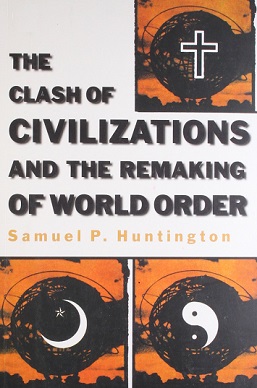
Grégoire Canlorbe: What do you think of Samuel Huntington’s classification of contemporary civilizations — and on his claim that the twenty-first century’s struggles will be neither economically nor racially motivated, but instead “civilizational” clashes? Did Huntington understand the WASP civilizational model?
Drew Fraser: Huntington thought that clashes between civilizations were the greatest threat to world peace but, at the same time, looked to an international order based on civilizations as the best safeguard against war. He probably overestimated the unity, cohesion, and cultural continuity of the major civilizations. Nowhere is that more obvious than in the case of Western civilization.
The Clash of Civilizations and the Remaking of World OrderThe United States, according to Huntington, is the core state of Western civilization. He believed that the United States has a core “Anglo-Protestant culture.” He recognized that mass immigration was a serious threat to the survival of that core culture, but held to the vain hope that new immigrants could and would assimilate.
His analysis rested also on the assumption that the core Anglo-Protestant culture established in the British North American colonies had survived intact to the present day. In fact, the character of the American people was altogether different in the colonial and early republican periods. Sociologist David Riesman described the dominant character-type of those days as “inner-directed.” Knowing the difference between right and wrong, early Americans were “rugged individualists,” possessing a sort of inbuilt psychic gyroscope that enabled them to stay on course, whatever the obstacles.
Nowadays, most Americans (especially those in the managerial-professional elites) display an “other-directed” character of the sort essential to success in corporate, government, and academic bureaucracies. According to Robert Jackall, the moral ethos prevalent in managerial circles is “most notable for its lack of fixedness.” The other-directed character requires, not an internal gyroscope, but a sort of radar able to pick up minute shifts in the fluctuating relationships with others in a mass-mediated social order.
The rootless cosmopolitanism of an other-directed corporate culture is driven by an “essential, pervasive, and thoroughgoing pragmatism.” In modern multiracial mass societies, the early republican constitution of liberty was replaced by a corporatist constitution of control promoting the growth and vitality of an increasingly plutocratic globalist system.
Samuel P. Huntington
Samuel P. Huntington (Credit Image: © Imago via ZUMA Press)
Amidst the ruins of their ancestral bioculture, WASPs throughout the Anglosphere have been abandoned by Woke corporate welfare states that no longer even pretend to represent them. WASPs are now de facto, if not yet de jure, a stateless people. Only by falling back on their ancestral racial and ethnic identity will ordinary WASPs find the spiritual strength to turn the tables on cosmopolitan elites. It is those faithless elites, not other civilizations, that pose the greatest existential threat to the Anglo-Saxon peoples.
Grégoire Canlorbe: In your most recent article, you enjoin “virtuous WASPs” to “challenge the corrupt globalist plutocracy misgoverning the Anglosphere.” Who are exactly those plutocrats — and how should they be fought?
Drew Fraser: The modern Anglo-American business corporation is a product of the managerial revolution. For more than a century now, ownership of the business corporation has been separated from control. Shareholders are no longer responsible for the corporate governance. Complex systems of corporate finance have created interlocking structures of control, concentrating power in the hands of an irresponsible plutocratic oligarchy.
That plutocracy is made up of people from a wide range of ethnicities. Throughout the Anglosphere, Jews play prominent roles in finance, media, academia, the law, and politics. Other ethnic groups have found niches of their own, such as the Indians in Silicon Valley. While no one ethnic group dominates the globalist plutocracy numerically — even WASPs can still be found within its ranks — there is little doubt that what E. Michael Jones calls “the Jewish revolutionary spirit” provides what amounts to its guiding ideology.
Sundar Pichai
Google CEO Sundar Pichai testified before the House Judiciary Committee on Capitol Hill. (Credit Image: © Jeff Malet / Newscom via ZUMA Press)
WASPs are largely responsible for the invention of both the nation-state and the modern business corporation. I believe WASPs have an ethnoreligious duty, therefore, to clean up the mess that they and others have made of their biocultures and its extended phenotypes (or Lebenswelt as a German might put it more poetically). Having become a stateless people, the WASP diaspora ought to re-model itself to some degree on the experience of the other, once-stateless diaspora; namely, the Jews.
In other words, like the Jews, WASPs should be more than the ethnomasochistic people-in-itself that they are at present; they can and should become an ethnocentric people-for-itself. The one essential lesson they must learn from Jews is that it is morally permissible, indeed obligatory, to ask of every public policy, corporate institution, and religious practice one simple question; namely, “Is it good for the WASPs?”
WASPs need to regenerate the ethnoreligious spirit of the early medieval Angelcynn [an Old English word for the English people or nation] church. In the time of Alfred the Great (849-899), the church provided the embryonic English people with the first intimation that they, too, could become, a “holy nation” destined to do God’s work in healing a wounded world. The most important task of a resurrected Angelcynn church and its ancillary educational institutions will be to prepare WASPs to play a leading role in the reconstitution of a responsible ruling class.
Just how one major aspect of such a program might be accomplished is the subject of my forthcoming book on the republican reformation of corporate governance. It is to be published by Arktos Media. It is: Reinventing Aristocracy in the Age of Woke Capital: How Honourable WASP Elites Could Rescue Our Civilization from Bad Governance by Irresponsible Corporate Plutocrats.
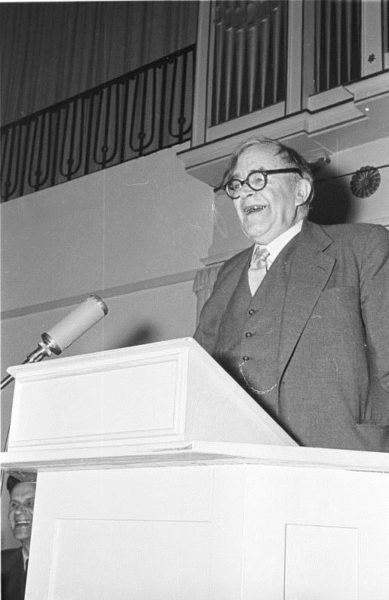
Grégoire Canlorbe: You have written about the “German Church Struggle” in the 1930s — and how the victory of the side most famously represented by Karl Barth encouraged the cosmopolitan character of Christianity in the whole West. What alternative is there to the deracinated universalism of mainstream Christianity?
Karl Barth
Karl Barth in 1956 (Credit Image: Hans Lachmann via Wikimedia)
Drew Fraser: The story of the conflict within German Protestant churches between supporters and opponents of the National Socialist regime is known as the Kirchenkampf. Mainstream historical writing on the church struggle typically rests on one unshakeable premise; namely, that, even before the war, the National Socialists, generally, and Adolf Hitler, in particular, were culpably criminal and irredeemably evil.
Karl Barth played a leading role in organizing ecclesiastical opposition to Hitler’s regime and its German Christian supporters. At the end of the war, Barth emerged as the clear victor over his völkische [“folkish” or national] rivals in the Protestant churches. By the 1960s, he was a world-renowned religious thinker, even appearing on the cover of Time magazine. He gave an enormous boost to cosmopolitan Christianity by rejecting any Volkskirche [national church] by denying that either nations or nationality were any part of the divinely-ordained order of creation.
Barth refused to acknowledge that the Church can “be regarded as a human production.” He insisted that the Church does not owe its existence to this world; rather its being is “secured, unthreatened, and incontestable only from above, only from God, not from below, not from the side of its human members.”
By contrast, the ideal of the Volkskirche rejected by Barth and his ecclesiastical allies held that “in the national determination of man we have an order of creation no less than in the relationship of man and woman and parents and children.” But mainstream Christians in every erstwhile Anglo-Saxon country now regard their own peoples as merely historical constructs whose purely contingent national identity cannot be identified as a command of God or a presupposition of the divine order of things.
Barth’s complete ideological triumph has effectively licensed the virtual extinction of Christian nationhood throughout the Western world.
Grégoire Canlorbe: What has been the fate of the Anglican Church in Australia compared to Western Christianity’s other denominations?
Drew Fraser: The Anglican Church of Australia, especially in its Sydney Diocese, regards itself as Christian first, evangelical second, and Anglican a distant third.In his 2012 Presidential Address, the then-Archbishop of Sydney, Peter Jensen lent fulsome support to the transformation of Sydney into a multiracial global city. He celebrated the fact that between 2006 and 2011 over 300,000 migrants arrived in Sydney from over 216 countries. He was not at all worried that China and India now dominate the countries of origin.
Anglicans in Australia
People who identify as Anglican as a percentage of the total population in Australia at the 2011 census, divided geographically by statistical local area. (Credit Image: Toby Hudson based on data from the Australian Bureau of Statistics via Wikimedia)
Just this year, the Sydney Diocese elected as its new Archbishop a Buddhist adult convert to Christianity whose Sri Lankan parents migrated to Australia when he was a young child. Clearly, Sydney Anglicans have no interest in the survival of a national church nurturing and preserving the ethnoreligious identity of the white Anglo-Saxon Protestants whose ancestors founded the Church of England in Australia.
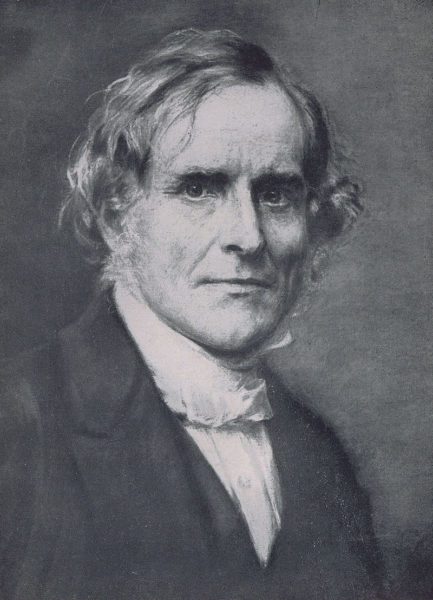
This represents a sharp departure from the hopes invested in the Broad-Church movement in the 19th century Church of England.First John 5:6-8 tells us that the Trinitarian character of a holy people is found in the “three who bear witness on earth: the Spirit, the water, and the blood; and these three agree as one.”At least one Anglican theologian, Frederick Denison Maurice (1805-1872), located the Spirit, the water, and the blood in the tripartite spiritual constitution of every national church.
Maurice defended the Trinitarian unity of family, church, and nation. Unfortunately, the Anglican Church of Australia and elsewhere has rejected such a traditionalist theology. Instead, WASPs in the Australian Church have embraced the secular cult of human equality with all the enthusiasm their middle-class English souls can muster.
Frederick Denison Maurice
Anglo-Australian Anglicans have missed altogether the theological point and purpose of Australian nationhood. Indeed, the Church has joined forces with the State to siphon off the Spirit and the water from the blood-faith of its Angelcynn forebears. The amorphous mass of individualistic WASP Anglicans must be satisfied with the thin gruel offered to them by a “public theology” engaged in the competitive (indeed pathological) display of out-group altruism that characterizes evangelical mission in a post-Christian world.
Grégoire Canlorbe: You suggest theology as the “queen of the racial sciences”—and race as a trinitarian phenomenon paralleling the trinitarian deity. Thus you envision “race-as-biology,” “race-as-ethnicity,” and “race-as-theology” as the three elements of race—especially in the white man. Please tell us more.
Drew Fraser: There are three dimensions to racial and ethnic identity. The first, race-as-biology, promises to shed light on the relationship between blood and behavior as manifested in measurable group differences such as average intelligence, temperament, and reproductive strategies.
By contrast, race-as-ethnicity deals with the myths and symbols that move men to collective action. As Hannah Arendt observed, to act, “in the most general sense, means to take an initiative, to begin . . . to set something in motion.” The actor is someone who starts something new. Applied to the birth of an ethno-nation, her insights suggest that action promotes the process of ethnogenesis in two stages: (1) the beginning made by a charismatic leader; and (2) the subsequent construction of a novel collective identity by his followers.
Sigrdrífa
The valkyrie Sigrdrífa says a pagan Norse prayer in Sigrdrífumál. (Illustration by Arthur Rackham via Wikimedia)
No wonder, then, that the imagined community of Christians appeared in late antiquity “in the guise of a miracle.” Not even the most devout Jews longing for the messianic restoration of national Israel expected what actually came to pass. Against all the odds, Christians—this new race of men—were moved by the Spirit to accomplish their divinely-appointed mission.
Race-as-theology helps us to understand how Spirit and blood mingled with the life-giving power of water to sustain the first, embryonic Christian communities. Since then, Christian nationhood has been nourished by the continuing interplay of Spirit, water, and blood. But disorder or dysfunction in one or more of those elements has led many nations to defeat and destruction.
Even the most atheistic practitioners of race-as-biology concede that a shared religious faith is likely to enhance the inclusive fitness of any race or nation. Conversely, the essentially trinitarian character of Christian nationhood is subverted when the unitarian logic of biology suppresses the theological dimension of racial or ethnic identity.
But a one-dimensional obsession with race-as-theology is no less productive of disastrous consequences. The now-dominant unitarian theology of cosmopolitan Christianity asserts that there is only one race, the human race. The denial by “anti-racists” of the fixed, intractable, biological character of the observable differences between various groups provides ideological cover for the deliberate displacement of white Europeans in favor of non-white immigrants.
Differences between Negroes, white Europeans, and Orientals are part of the divinely-ordered nature of things. Race is a theological not just a biological or cultural phenomenon. Those who refuse to recognize the theological significance of race do so at their peril.
Grégoire Canlorbe: Could you remind us of your case for a “patriotic king” in Australia, a wording you borrow from a book by Henry St. John, 1st Viscount Bolingbroke (1678-1751)?
Drew Fraser: Royalty plays a central role in the Bible story. Jesus the Christ traced his descent from King David. As the very model of an English David, Alfred the Great established a Christian kingdom in England. The hereditary monarch of the British dominions once served as trustee-in-chief for his realm. The religious significance of the monarchy was given formal recognition when Henry VIII and his heirs and successors were declared to be Supreme Governors of the Church of England. The Royal Supremacy played a significant role in the rise of the Broad-Church movement in the 19th century Church of England. Nowadays, it has become little more than a hollow simulacrum of the putative royal authority vested in a shapeshifting Crown. As in secular matters, the reigning monarch exercises the Royal Supremacy as a rubber stamp for any government of the United Kingdom commanding a majority in the House of Commons.
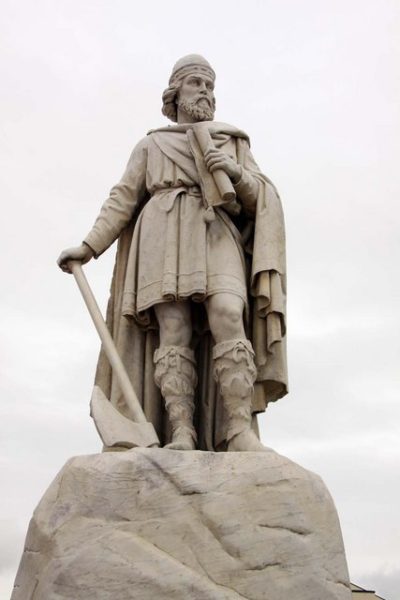
Statue of Alfred the Great
Statue of Alfred the Great at Wantage, Oxfordshire. (Credit Image: Steve Daniels via Wikimedia)
A major objective of a future network of Angelcynn churches throughout the Anglosphere should be to rescue the captive Crown in right of the Royal Supremacy from corrupt politicians with no demonstrable interest in the spiritual welfare of Anglo-Saxons “at home” or in the diaspora. Once Royal Supremacy over the Church of England has been insulated from political control, it should be extended to every reformed Angelcynn Church, not just in the United Kingdom, but throughout the British dominions as well.In time, it may become possible for the Crown to charter Angelcynn churches, even in what remains of the American republic.
In the eighteenth century, Henry St. John, Viscount Bolingbroke, appalled by the blatant corruption of the ruling Whig oligarchy, hoped that the idea of a Patriot King would re-awaken the English nation from its spiritual slumbers. The appearance of such a patriot prince would have been a miracle. In our own time, it is doubly hard to imagine a British prince daring to stand against a government determined to maintain its control over the royal prerogative in ecclesiastical affairs. But, as Bolingbroke wrote, those who pray for such a deliverance must not neglect such means as are in their power “to keep the cause of reason, of virtue, and of liberty alive.” The blessing of a patriot prince might indeed “be withheld from us” but to “deserve at least that it be granted to us, let us prepare to receive it, to improve it, and to cooperate with it.”
Bolingbroke knew that were a patriot prince to campaign in defense of the monarchy, he would be subject to a raging torrent of criticism and abuse. Yet when a good prince is seen “to suffer with the people, and in some measure for them . . . many advantages would accrue to him.” For one thing, the cause of the British peoples generally “and his own cause would be made the same by their common enemies.”
What is the nature of that cause? In short, acting as the Supreme Governor of an Angelcynn communion extending throughout the Anglosphere, a patriot prince will call forth a spirit of resistance to both managerial statism and the abstract universalism of globalist plutocracy. He will do everything in his power to civilize those wild and immoral forces. But the appearance of a Patriot King is not inevitable. Indeed, only a people whose lost liberties are restored to memory will recognize his coming as an opportunity to reshape their allegedly preordained future.
Anglo-Saxon republicans may yet be compelled to call upon God to save the King. As things stand now, the ritual absence of the monarch from everyday life is but one more sign that we are no longer a serious people. Forswearing the faith of our fathers, we surrender our bodies to the state and our souls to the degenerate society of the spectacle. It would be a sign of spiritual and moral progress were we to wish that a Patriot King will come to save us.
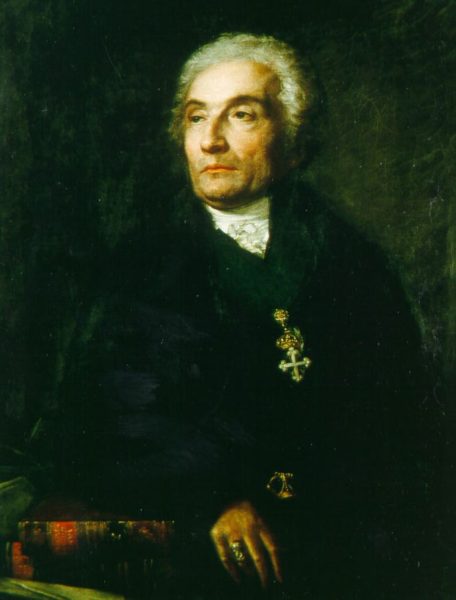
Joseph de Maistre
Joseph de Maistre, perhaps the most eloquent proponent of “throne and altar” ideology.
In effect, the idea of a Patriot King would serve as a Sorelian myth, inspiring WASPs to act in opposition to an irresponsible and corrupt plutocratic system demanding automatic obedience and mindless conformity. For the radical French syndicalist Georges Sorel (1847-1922), men cannot be galvanized into action through discourse or considered analysis. According to historian Irving Louis Horowitz, Sorel viewed action as “the outcome of an appeal to imagination and intuition, which dramatizes the consequences of an act rather than [offering] a reasoned prediction of those consequences.”
An ethnoreligious appeal to the idea of a Patriot King will nourish WASPs around the world “on the strength of kinship and community feeling; on the ability to act as a collective unit.” To act as a whole, as a united people, WASPs will need to focus on a single unifying element. As a Sorelian myth, the pragmatic value of the idea of a Patriot King will not depend on its “objectively primary content as such, but simply the quality of making men cohere in a common endeavour.”
Remember, though: a king is, indeed, like unto God; he cannot save those who will not save themselves. Those who pray for the miraculous appearance of a Patriot King must make themselves worthy of such a blessing. The resurrection of the Angelcynn church will be but the first step in the salvation of the WASPs. Much else will need to be done if virtuous WASPs are to create and secure “little republics” of their own on the fiercely-contested terrain of a transnational civil society.
Grégoire Canlorbe: You studied the “theological significance of the destruction of the Jerusalem temple in AD 70.” What would be the political, “theological significance” of the reconstruction of the Jerusalem temple—and of the reestablishment of the priestly caste attached to its service?
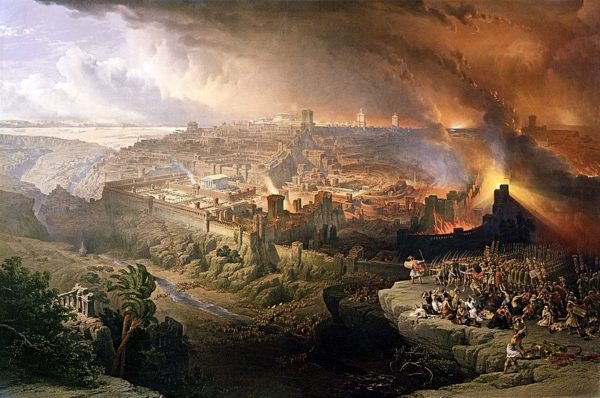
The Siege and Destruction of Jerusalem, by David Roberts (1850).
Drew Fraser: Mainstream Christianity rests upon some version of a futurist eschatology. That is to say, most Christians, Catholics and Protestants alike, believe that the Bible reveals the salvation history and destiny of humanity from the creation of planet earth in Genesis until the end of the world at the Second Coming of Jesus Christ. Belief in the prophesied end of the world takes several forms. Most Christians are “amillennialists” who take no firm position of when or how the Second Coming will take place. “Post-millennialists,” by contrast, believe that Christ will return only after the kingdom of God has established its dominion to the ends of the earth.
Christian Zionists (aka “dispensationalists”) believe that the reconstruction of the Jerusalem Temple will inaugurate the Millennial (thousand-year) reign of Jesus Christ here on earth in preparation for the Last Judgement. On this view, the establishment of the Israeli state in 1948 was in partial fulfillment of God’s promise of salvation to all Christians.
Not all Christians, however, accept the deeply-entrenched (though competing) ecclesiastical traditions grounded in a futurist eschatology. Preterists (from the Latin praeter meaning “past”) hold that the Bible story effectively comes to an end with the destruction of the Temple in AD 70. Their reading of the bible story suggests that those who look forward to the return of Jesus Christ at the end of the world are misinterpreting the Bible in accordance with presuppositions grounded in a false hermeneutic. Futurist eschatology, preterists say, is unbiblical.
Preterists hold to a covenantal eschatology grounded in a Hebrew hermeneutic according to which the Bible story has to do with the rise and fall of Old Covenant Israel. They insist that the clear text of Scripture shows that all of the biblical prophecies of a new heaven and a new earth, not just those in Revelations, were fulfilled in AD 70. In August of that year, Christ came (the Parousia or Second Coming) to oversee the destruction of the temple in Jerusalem, the physical center of the old heaven and old earth occupied by God’s first people. In Revelation, we see the Old Covenant world of Israel sinking into lakes of fire, while the New Covenant enters into history to create a new heaven and new earth. The Jerusalem Temple makes its exit in a spectacular cataclysm. The new creation becomes incarnate in the church, the ecclesiastical Body of Christ, which by AD 70 has been carried to the ends of the known world. There the bible story ends.Dissident DispatchesThe Old Covenant bound the holy nation of Israel to God; the New Covenant extended the grace of God to every nation (ethnos) of the oikumene. The leaves of the tree of life in the New Jerusalem were to serve for “the healing of nations.” Old Israel was no more. On Judgement Day, Christ sentenced the stiff-necked synagogue of Satan to spiritual death. Only a righteous remnant was left to carry the holy seed of Israel unto the nations. For almost two thousand years, every Christian nation adjured Jews within their realm to recognize their Redeemer, thus ending their age-old rebellion against God. In sharp contrast to the Jews, Anglo-Saxons eagerly entered into the new covenant world.
A preterist biblical hermeneutic is clearly opposed to Christian Zionist dispensationalism. The reconstruction of the Jerusalem Temple by the modern Israeli state cannot be justified theologically within the framework of covenant eschatology. (It would, of course, signal a blasphemous desire to reverse the divine judgement on Old Covenant Israel.)
On a positive note, preterism provides a warrant for an Angelcynn ethnonational church aiming to raise up WASPs as a holy nation in their own right. Such a warrant was clearly exercised when the early Christian church recognized a biocultural affinity between the covenantal language of the Bible itself and the prominent place occupied by covenants in tribal social structures of Old England.
Conversely, once Anglo-Saxon churches downplayed the importance of blood covenants to the spiritual life of both family and nation, the ancestral attachment of Anglo-Saxon Protestants to the Body of Christ began to fade away. The civil religion of the modern Anglican church, focused as it is on personal salvation, refuses to recognize itself as the spiritual home of the large, partly-inbred extended family that constitutes the Anglo-Saxon ethny. No such bloodless faith will ever give birth to a holy nation in the eyes of God.
Contemporary WASPs drawing upon the wisdom enshrined in Holy Scripture will recognize that their own ethnonation, no less than ancient Israel, must ground itself in a divinely-ordained covenant between the dead, the living, and the unborn. The living members of a godly nation will see themselves as the trustees of the family blood, rights, property, name, and position for their lifetime. They have an inheritance from the past to be developed and preserved for the future. Along with its warrant for nationhood and a storehouse of wisdom for all ages, the biblical fate of Old Covenant Israel stands as a clear warning to any nation breaching its covenantal obligations to God and man.
Grégoire Canlorbe: Thank you for your time. Please, feel free to add anything else.
Drew Fraser: Thanks for the opportunity to do this. I found your questions quite stimulating.

Tuesday, March 9, 2021

"Try To Be Less White ." Racist Training at Coca-Cola

 To be less white is: to be less oppressive, to be less arrogant, to be less trusting, to be less defensive, to be less ignorant, to be more humble, to listen, to believe. , break with apathy and break with white solidarity ” .

Another says that "in the United States and other Western nations, whites are socialized to feel that they are inherently superior because they are white ." And they finish with an invitation: "Try to be less white ."

The seminar entitled 'Facing Racism', given by Robin DiAngelo

Tuesday, November 10, 2020

A Brief History of Nonwhite Slave Owners in America


https://mises.org/wire/brief-history-nonwhite-slave-owners-america

TAGS U.S. HistoryWorld History

11/09/2020

The study of slavery is one of the most contentious issues in contemporary America. But frequently this history is abused by thinkers across the spectrum to score political points. To understand the complexity of such an institution, we must desist from underestimating the role of minorities such as African Americans and Native Americans in it. For much of history, slavery was the norm, and by downplaying nonwhites' involvement, we diminish their humanity. Pursuing one's self-interest to acquire profit or power is consistent with human nature. Depicting minorities as innately virtuous relegates them to the status of infants. Instead, we should aim to highlight their autonomy as rational agents who sought to fulfill specific objectives in the context of a slave economy. Blacks and American Indians possessed the capacity to be just as calculating as white slave owners, and it is patronizing to suggest that they failed to perform as self-interested actors.

One of the earliest reports on black slave owners was pioneered by historian and activist Carter G. Woodson. Woodson advanced what is widely known as the theory of "benevolent slaveholding." According to this view, black slaveholders primarily purchased relatives and friends from white masters to provide them with a better quality of life. To curtail the growth of the free black population, restrictive laws were instituted, thus making it difficult for black slave owners to manumit slaves without approval from the state. In South Carolina, for example, after 1820 free blacks who bought relatives, spouses, or friends had to receive permission from the state prior to manumitting enslaved Americans. Hence, purchasing black slaves from white owners was a strategy used by free blacks to secure a greater degree of freedom for their loved ones. Indeed Woodson's thesis remains popular among academics, as adumbrated by Philip J. Schwarz: "Increasingly restrictive legislation, stringent economic conditions, the choice of many free blacks to own other blacks only temporarily, and perhaps the aversion of other Afro-Americans to human bondage guaranteed, that free black possession of human property would be significant only as an anomaly, not as a typical experience." Though Woodson's theory is still influential, many have charged that he minimized the materialistic tendencies of African American slave owners. 

Larry Koger in his groundbreaking text Black Slaveowners: Free Black Masters in South Carolina, 1790–1860 disputes the dominant narrative propagated by disciples of Woodson:

When Carter G. Woodson asserted that free blacks purchased slave relatives and friends, he was quite correct. However, free blacks who held loved ones bought other slaves to be exploited for profit. To classify these transactions as benevolent would be a mistake. Even though these slaveowners usually demonstrated benevolent behavior towards their slave relations and friends, a commercial and materialistic exchange existed between them and their slaves purchased as investments. In fact, the free blacks who maintained a dual relationship with their slaves had no universal commitment against slavery. To them, slavery was an oppressive institution when it affected a beloved relative or a trusted friend, but beyond that realm, slavery was viewed as a profit-making institution to be exploited.

Other scholars implore us to not be shocked that blacks in America expressed an interest in owning slaves, as summarized by Calvin Wilson: "The Negroes brought with them from their native land African ideas and customs. Many of those brought thence to America had been slaves in their own lands. Others had been owners of slaves in Africa. In both cases, they were used to slavery. It did not, therefore, seemed unnatural for a Negro in America to hold his brethren in bondage when he had become free and able to buy his fellows."

Also, like their white peers, some black slave owners were notorious for their brutality. Ronald E. Hall in his landmark publication An Historical Analysis of Skin Colour Discrimination: Victimism among Victim Group Populations challenges the assumption that black owners were always humane using the example of William Ellison: "William Ellison is prominent for both his wealth and the cruelty toward his black slaves, for which he was known among Southern blacks and whites. Historians for whatever reasons have attempted to justify his version of victim-group discrimination perhaps as a matter of political correctness."

Yet if you assume that Hall’s commentary on Ellison is an anomalous case, then maybe this condemnation of black slave owners by a Louisiana slave featured in Frederick Law Olmstead’s Journeys and Explorations in the Cotton Kingdom will alter your perspective: “You might think, master, dat dey would be good to dar own nation; but dey is not. I will tell you de truth, massa; I know I’se got to answer; and it’s a fact, dey is very bad masters, sar. I’d rather be a servant to any man in de world, dan to a brack man. If I was sold to a brack man, I’d drown myself. I would dat—I’d drown myself! Dough I shouldn’t like to do dat nudder; but I wouldn’t be sold to a coloured master for anything.” Clearly, Woodson’s thesis is untenable.

With greater potency than most writers Hall discredits the position that black slaveholders were mainly motivated by humanitarian concerns:

In most instances of black slave ownership, the records suggest that blacks who owned black slaves did so for the same reasons as whites: profit….Astonishingly, in 1860 there existed at least six Negroes—likely light-skinned—living in Louisiana who owned 65 or more slaves. Among them C. Richards and P.C. Richards who owned 152 of their black brethren as slaves to work their sugarcane plantation. A similarly impressive Louisiana free Negro Antoine Dubuclet owned in excess of 100 dark-skinned black slaves. He was also in the sugar business and boasted an estate estimated to be worth in (1860 dollars) $264,000. To put Dubuclet's wealth in context, the mean calculation of wealth for Southern white men at the time averaged $3,978.

Similarly, Native Americans were also players in slavery, and it must be noted that the institution existed before the arrival of Europeans. According to the scholar Joyce Ann Kievit: "Many North American Indian tribes practiced some form of slavery before Europeans arrived in North America. The status of slaves varied from tribe to tribe. Some slaves were exploited for labor, others were used for ritual sacrifice, a few provided for the needs of women whose husbands had been slain in war, and many were adopted into the tribes." However, with the introduction of plantation slavery by European settlers, Native Americans became alert to the financial opportunities that could be gained from this venture.

Barbara Krauthamer shrewdly dispels the notion that Native Americans had less interest in exploiting black slaves for monetary benefit:

From the late eighteenth century through the end of the U.S. Civil War, Choctaw and Chickasaw men and women held people of African descent in slavery. Like their white Southern counterparts, Indians bought, sold, owned, and exploited black people's labor and reproduction for social and economic gain. Choctaws and Chickasaws purchased slaves—men, women, and children—to work on their Mississippi farms and plantations and to serve in their homes…Choctaws and Chickasaws understood that slavery allowed for the accumulation of personal wealth.

Neither should we entertain the fable that Indian slave owners were universally generous. R. Halliburton in an intriguing book, Red over Black: Black Slavery among the Cherokee Indians, argued that the treatment meted out to black slaves ranged from kind to excessively atrocious, indicating that generalizations about slave masters are often inaccurate.

To imply that only white people have a vicious ability to calculatingly pursue their interests at the expense of others is insulting to blacks and American Indians. Inherent in humans is the passion to achieve distinct objectives even when they are inconsistent with the goals of the wider group. Romanticizing the history of minorities to portray them as saints is quite dehumanizing. The racist subtext is that white people are uniquely human because they possess the fortitude to outwit competitors. 

Author:

Contact Lipton Matthews

Lipton Matthews is a researcher, business analyst, and contributor to mises.org, The Federalist, and the Jamaica Gleaner. He may be contacted at lo_matthews@yahoo.com or on Twitter (@matthewslipton).


Black Fragility (Def.) by Mark Dice

  Discomfort and defensiveness on the part of some black people who live in a predominately White culture. Due to fixating on long gone past...